A queue management system in an airport or transport hub is a system that tells the people who run the building how long queues are, how long passengers wait and which points are getting crowded, so they can open service lanes, move staff or inform passengers in time. This matters more and more in Thailand. Financial results reports say the six airports operated by Airports of Thailand Public Company Limited handled about 99 million passengers between October 2025 and June 2026, and the airport expansion plan aims to handle more than 160 million passengers a year by 2034. This article explains what a queue and passenger flow management system measures, what it is used for and how to write the specifications when procuring one.
How Many Types of Queue Management System Are There?
The term covers two groups of systems that work very differently.
| Type | How it works | Suited to |
|---|---|---|
| Ticketing / virtual queue system | The person taking the service takes a ticket or books a place in the queue, and the system calls them in order | Banks, hospitals and service agencies where people can sit and wait |
| Sensor-based queue measurement | Sensors above the queue automatically measure the number of people, queue length and actual waiting time | Airports, transport hubs, checkpoints and check-in areas where passengers stand in line and keep flowing |
In airports and transport hubs, passengers already walk forward in line in order. So what the operator needs is not a ticketing system but "real data" on how each queue is doing right now. This article mainly covers the second type.
What Are Crowd Management and Passenger Flow?
Crowd management is the planning and control of the movement of large numbers of people so that it is safe and smooth. Passenger flow is the route and rhythm at which passengers move through points in the building, from the entrance through check-in, security, immigration and on to the boarding gate. A passenger flow monitoring system brings the data from every point together, showing where bottlenecks occur and how they affect the next point.
Key Metrics the System Can Measure
| Metric | Meaning | What it is used for |
|---|---|---|
| Queue length | The number of people in the line right now | Deciding when to open more service lanes |
| Waiting time | Time from joining the line to reaching the service point, measured from people who actually passed through | Tracking service level and informing passengers on screens |
| Throughput | The number of people passing a service point per hour | Checking the efficiency of each lane and planning staffing |
| Occupancy | The number of people in a hall or waiting area right now | Monitoring density and safety |
| Dwell time | Time passengers spend in a zone, such as the retail area after security | Planning commercial space |
| Travel time between points | Time taken from one point to another | Finding bottlenecks along the whole journey |
For more on reading dwell time, see the article What Is Dwell Time?
Where to Measure in Airports and Transport Hubs
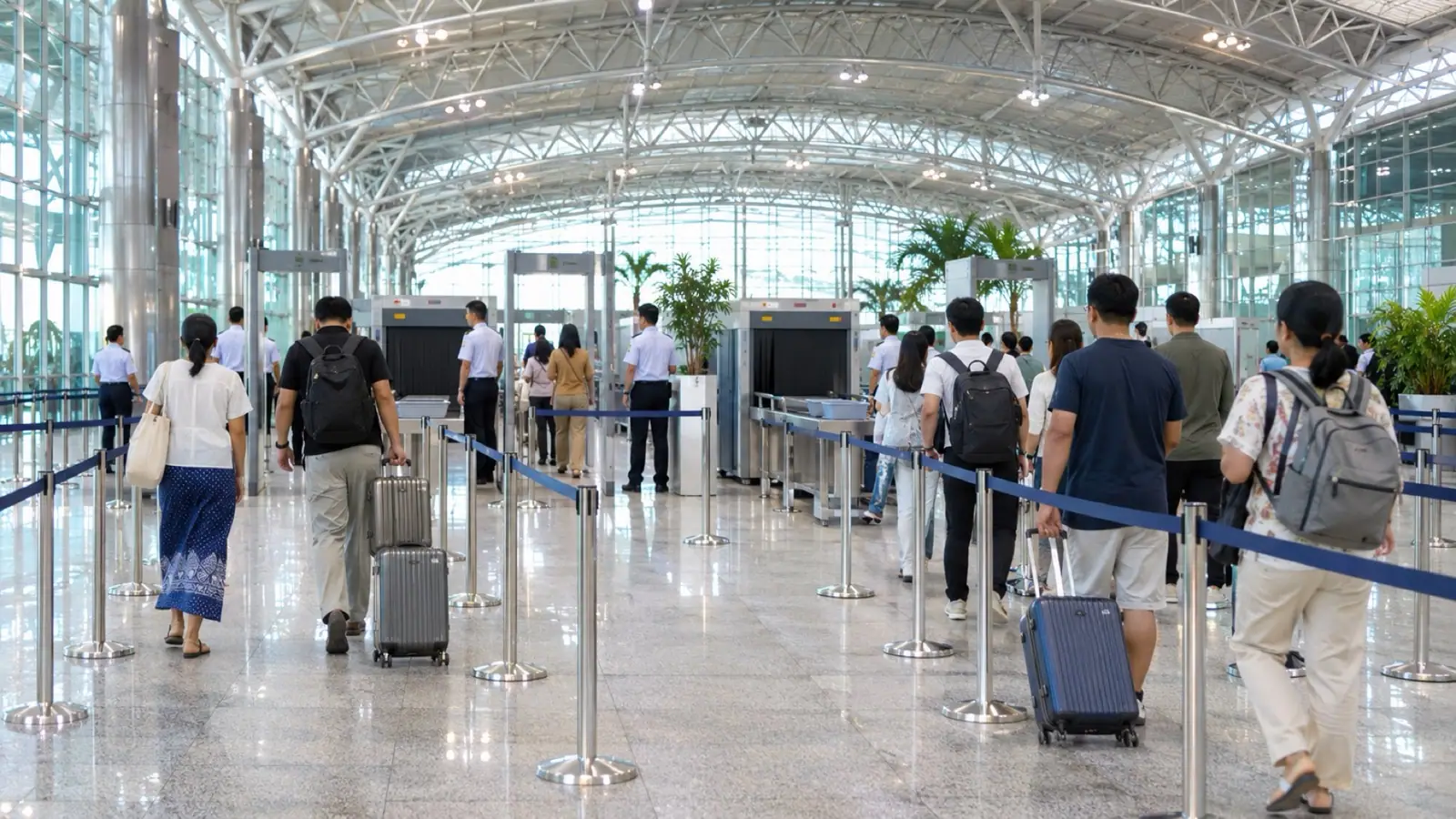
Airports: building entrances · check-in and bag-drop points · security checkpoints · departure and arrival immigration · retail and dining areas after security · boarding gates · baggage carousels · taxi and public transport waiting points
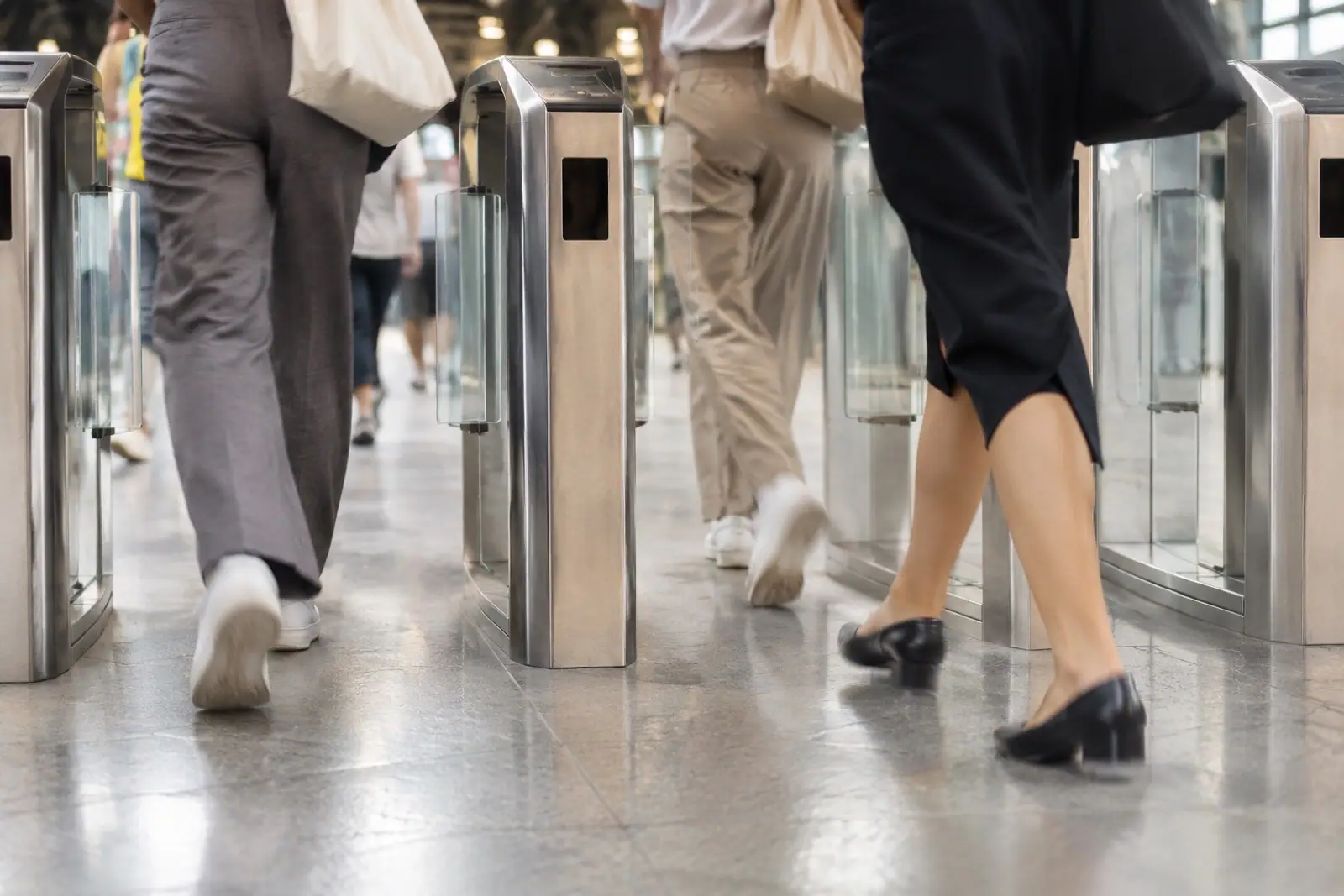
Train and rapid transit stations: fare gates · interchange links between lines · platforms · stairs and escalators · links to neighboring buildings
Bus and coach terminals: ticket counters · waiting areas · boarding lanes
How Can Sensors Measure Waiting Time Anonymously?
A 3D sensor is mounted on the ceiling above the queue and sees each passenger as a moving point. When a point enters the queue zone, the system starts a timer, and it stops when that point leaves the zone at the service point. Waiting time is therefore measured from the actual movement of each person in the line, without needing to know who that passenger is.
Xovis sensors process the image inside the device and output numerical data such as movement coordinates. There is no biometric or personal data. This matters to organizations that must comply with data protection law, in Thailand's case the Personal Data Protection Act. Read more in the article People Counting and the PDPA
What Can Passenger Flow Data Be Used For?
1. Real-time decisions on the floor
When a queue grows beyond a set level, the system alerts the shift supervisor to open more service lanes or move staff from a quieter point, before the queue spills out and affects other areas.
2. Telling passengers the waiting time
A screen showing the estimated waiting time helps passengers plan, for example by choosing a checkpoint with a shorter queue, and reduces anxiety while they wait.
3. Planning staffing in advance
Historical hourly data together with flight or train timetables helps schedule staff shifts to match the periods when passengers are densest.
4. Measuring service level and reporting
Organizations that set waiting-time targets use continuous data to track results, and in talks with related parties such as airlines, ground handlers and government agencies stationed at checkpoints.
5. Planning space and building improvements
When airports and stations are expanding, real flow data helps check whether the planned design can actually handle the passengers, and informs the design of new buildings.
6. Commercial space
Passengers who clear security faster have more time in the retail and dining areas. Visitor counts and dwell time in commercial zones help plan store layouts and talk with tenants.
7. Safety on crowded days
During festival periods or disruptions, occupancy data helps the operations team see which points are close to a crowded level, and decide faster on how to disperse people.
A Checklist for Writing Specifications When Procuring a System
An organization preparing procurement specifications (TOR) should state the following points clearly, written as required capabilities and not tied to any brand.
- Coverage area. The points to be measured, the size of the area and the ceiling height at each point.
- Metrics required. Queue length, waiting time, throughput, occupancy and the update frequency.
- How accuracy is proven. Specify an acceptance test comparing against manual or video counts over an agreed period, instead of accepting figures claimed by the vendor.
- Anonymity. Whether processing happens inside the device, whether images are stored, and what data is output.
- Data integration. The format for sending data into the organization's existing systems, such as building operations, display systems and reporting systems.
- Installation. Power supply, cabling, and models for outdoor or semi-outdoor areas.
- Remote device management. Configure, check status and update without having to climb up to the ceiling.
- Data retention. Retention period, server location and access rights.
- Dashboards and alerts. What each user group sees, and through which channels alerts are sent.
- Support after installation. A local team, response times and periodic calibration.
IMAS and Xovis Passenger Flow Monitoring Systems
IMAS is a partner of Xovis, the Swiss developer of 3D sensors used in airports, public transport, retail and buildings.
- Automatically counts passengers, detects queues as they form and measures the number of people in an area in real time.
- Processes data inside the sensor and outputs numerical data, with no biometric or personal data.
- Can be installed at a range of heights, from standard ceilings to high halls depending on the model, with models for outdoor areas.
- Powered over the LAN cable, configured and maintained remotely, and sends data through standard protocols into other systems.
- Data can be displayed and analyzed further in the XPERIO dashboard.
For solution details for this sector, see the page airports and transport hubs, and for examples of our work, see our projects page.
Data helps the operations team share one picture and decide faster. Decisions to open a lane, move staff or change a process remain with the shift supervisors who know the real situation.
Frequently asked questions
−What is a queue management system?
It is a system that helps manage queues. There is a ticketing type for services where people sit and wait, and a sensor-based type that measures real queues in areas where people stand in line, such as airports and transport hubs.
+How is a crowd management system different from a queue management system?
A queue management system focuses on the line at a service point. A crowd management system looks at the whole picture of people across an area, such as density in a hall, walking routes and points close to overcrowding. One set of sensors can provide data for both.
+Can waiting time really be measured anonymously?
Yes. A 3D sensor tracks movement as points inside the queue zone, then times from joining the line to reaching the service point, without needing to know who the person is.
+Can it be used in rapid transit stations?
Yes. Common measurement points are fare gates, interchange links, platforms and escalators.
+Where should we start?
Start with the point that is the clearest bottleneck and has the biggest effect on the passenger experience, such as the security checkpoint or immigration, then expand along the passenger journey.
Planning a queue or passenger flow measurement system?
The IMAS team can survey the site, plan sensor positions and provide information to support the preparation of specifications. Details and costs are given in the quotation.
Schedule a project discussion · See solutions for airports and transport hubs
References
- News reports on the financial results of Airports of Thailand Public Company Limited, fiscal year 2026 (passenger numbers, October 2025 to June 2026)
- News reports on the airport expansion plan of Airports of Thailand Public Company Limited (passenger capacity target for 2034)
- Xovis AG. Sensor technology and PC-Series Selection Guide (2024). xovis.com website