
A people counting system is the basic tool that shopping centers and retail chains use to answer a simple question: "How many people came in today, when did they arrive, and where did they go?" But once it is time to buy, many teams find that the technologies on the market differ widely, from low-cost infrared beams mounted beside a door to ceiling-mounted 3D vision sensors that can tell the walking direction of each person. This article compares the 5 main technologies, explains which kind of space each one suits, and gives a list of questions to ask vendors before you decide.
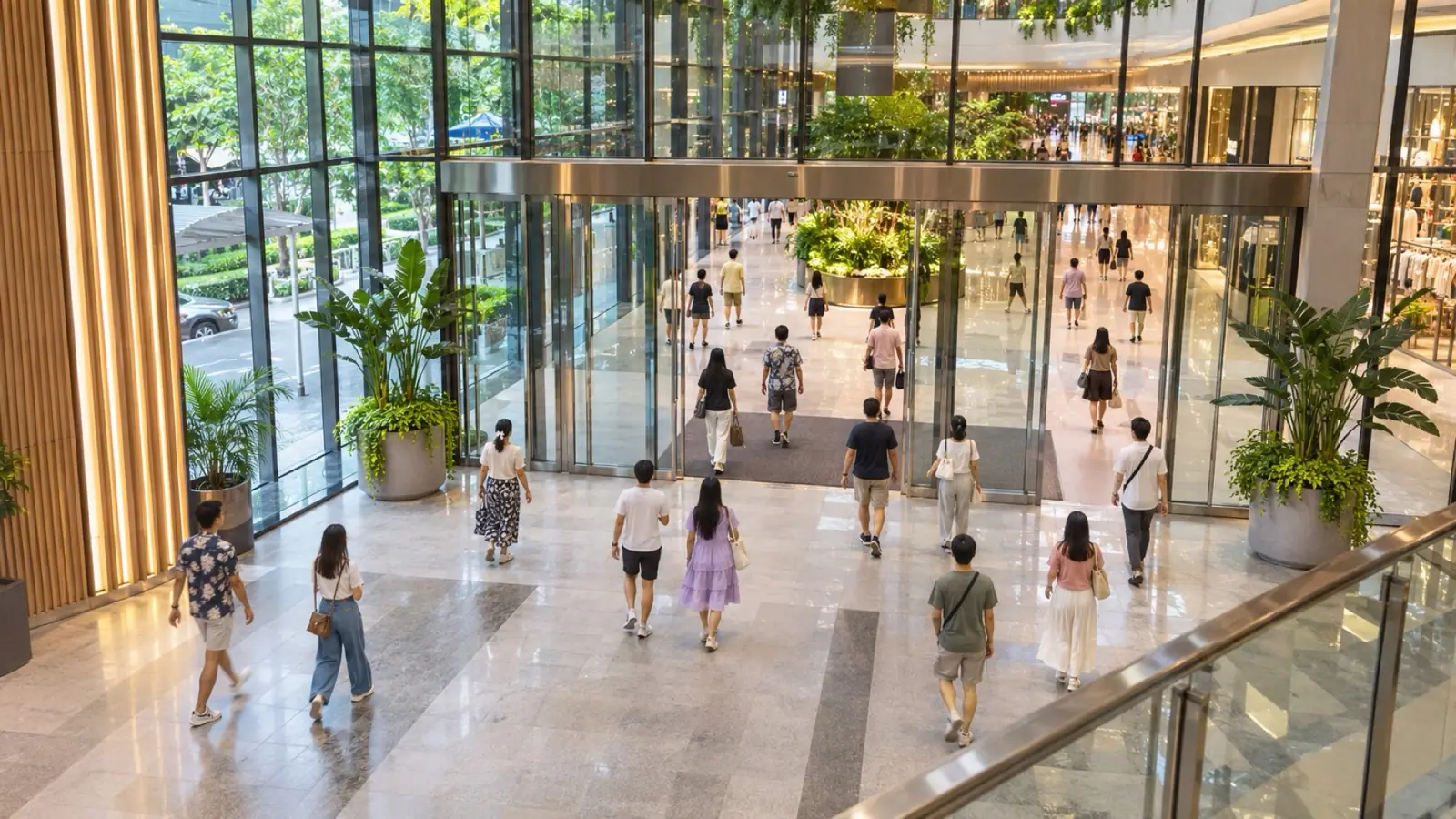
What is a people counting system, and what do malls use the numbers for?
A people counting system is a set of devices and software that counts the people passing a given point, usually an entrance or exit, and sends the numbers to a dashboard. More detailed systems also report direction (in or out), the number of people in the space at a given moment, the time people spend in a zone (dwell time), and where crowding occurs.
These numbers are useful to several teams in the same organization.
- Operations use them to see when traffic peaks, so they can staff security, cleaning and sales teams appropriately.
- Marketing uses them to measure whether an event or promotion really drew people in, by comparing against the same time period without the event.
- Leasing teams at shopping centers use visitor numbers in tenant negotiations and in planning the store layout.
- Branch managers at retail chains use them to calculate the conversion rate, which is the number of transactions divided by the number of people who entered the store. It shows whether sales fell because fewer people came in, or because people came in and did not buy.
- Building and energy teams use the real number of people in the building to help adjust air conditioning and lighting.
Because the numbers feed so many decisions, the accuracy of the counting system matters. If the count is far off when the space is crowded, every decision that follows is off as well.
The 5 main people counting technologies
1. Infrared beam
Devices are mounted on both sides of a door. One side emits an infrared beam to a receiver on the other side. When someone walks through the beam, the system registers one count. With two parallel beams, the system can tell entries from exits by the order in which the beams are broken.
The strengths are easy installation, a low cost per point, and no images being captured, so there is no issue with images of individuals. The limitation is that it cannot separate people who walk side by side or close together. Two people passing at the same time may be counted as one, a stroller or a large shopping bag may cause over-counting, and it works well only on narrow doors. This technology therefore suits small shops with a single door and light traffic better than a mall entrance several meters wide.
2. 2D camera
A single-lens camera is mounted on the ceiling and looks straight down. Software analyzes the image to find the shapes of people moving across a defined line, then counts by direction.
A 2D camera separates people walking side by side better than an infrared beam, and it covers wider entrances. But a 2D image has no height or depth information, so the system can be confused by shadows, reflections from glossy floors, sunlight shining through the door, or objects that are not people. Accuracy depends quite heavily on the lighting at each location, so before choosing you should look at the real lighting conditions both by day and by night.
3. 3D stereo vision sensor
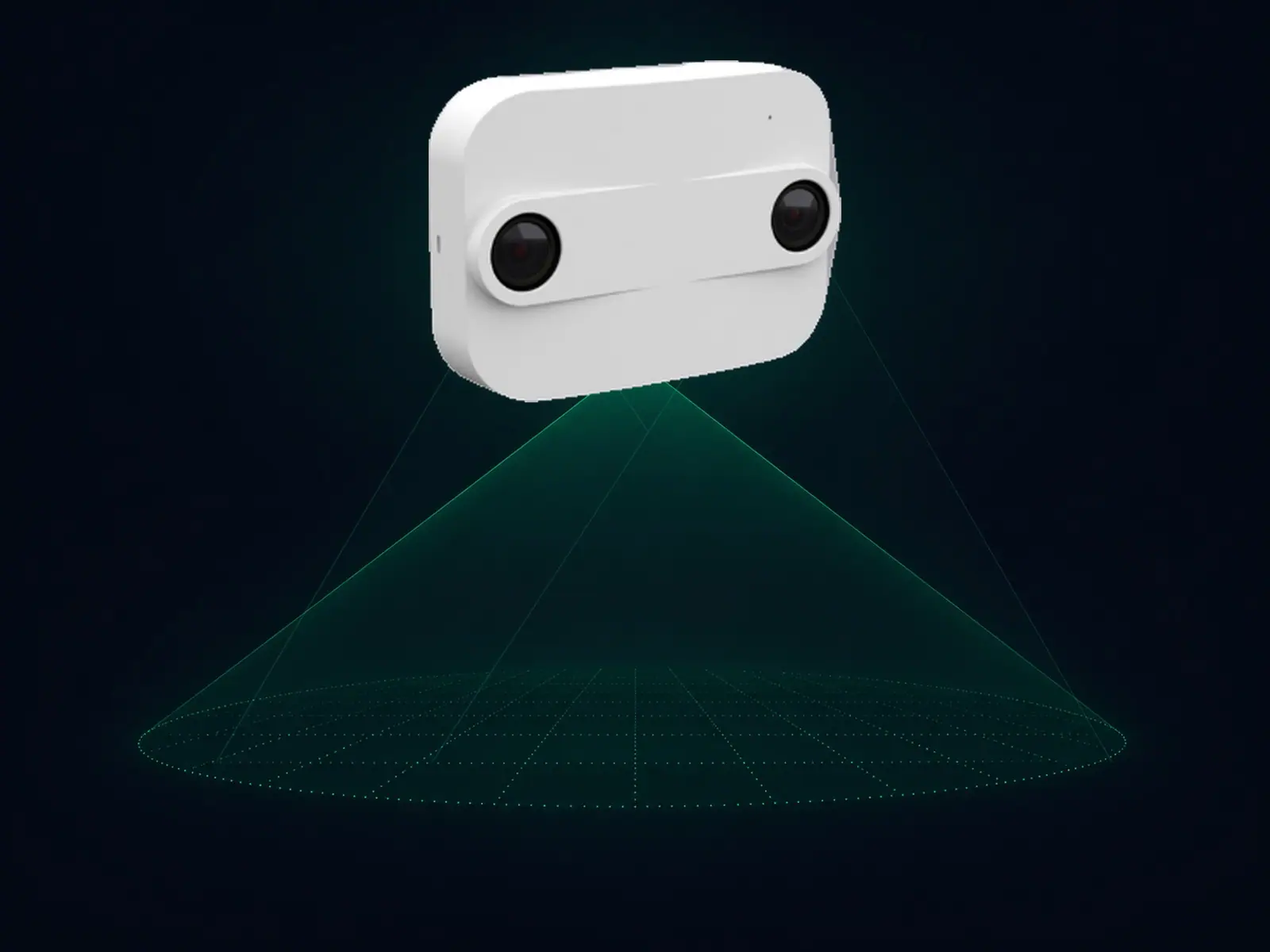
This type of sensor has two lenses, like human eyes, and is mounted on the ceiling looking down. It calculates a depth image from the difference between the two lenses' views. The system therefore knows the height of what is underneath, can separate people from shadows and objects, and can apply a height threshold to tell adults from children or to exclude strollers and carts. A related technology is the time-of-flight sensor, which measures the time light takes to travel out and back and also produces depth data.
The key advantage for malls and airports is that these sensors handle crowded periods well. Several sensors can be linked side by side to cover a wide entrance or a large hall, and they can follow walking paths inside the space, so they can also measure the time people spend in a zone and find crowded spots. Many 3D sensor makers design their devices to process images on the unit itself and export only numerical data, such as the number of people, time and path coordinates. Each model and each configuration differs, so you should always ask the vendor for written confirmation.
The limitation is a higher cost per point than infrared beams and 2D cameras, and installation must follow the ceiling height specified by the manufacturer. Whether it pays off therefore depends on how much the organization will use the numbers to make decisions.
4. Counting from Wi-Fi and Bluetooth signals
The system picks up the signals that mobile phones emit periodically and estimates the number of devices in an area. This approach covers a large area with few devices and can show movement between zones or between buildings.
The limitation is that what it counts is devices, not people. Some people carry two phones, some turn Wi-Fi off, and many newer phones randomly change their device identifier to prevent tracking. The results suit trend analysis better than exact counts, and because the signals are tied to individuals' devices, organizations should assess personal data issues before using it. In practice, many projects use Wi-Fi to supplement entrance sensors rather than replace them.
5. AI video analytics on CCTV footage
Artificial intelligence software reads the images from existing CCTV cameras and then counts people, finds crowded spots or performs other analysis. The selling point is that it reuses the existing cameras, so little new equipment is needed.
There are points to think through. CCTV cameras are installed for security, and their angle is often oblique rather than straight down from the ceiling, so people block each other when it is crowded. Counting accuracy from an oblique angle is usually lower than with sensors designed specifically for counting. In addition, CCTV images show faces and personal characteristics. If the software analyzes faces, age or gender, the organization must consider personal data issues carefully. Details are in the article People counting systems and PDPA, which covers Thailand's Personal Data Protection Act B.E. 2562 (2019).
Comparison table of the 5 technologies
| Technology | Principle | Strengths | Limitations | Privacy | Best suited for |
|---|---|---|---|---|---|
| Infrared beam | Counts when something breaks the beam | Easy to install, low cost per point | Cannot separate people walking in pairs; works only on narrow doors | No images captured | Small shops, single door, light traffic |
| 2D camera | Analyzes the shape of people from a top-down image | Covers wider doors, separates side-by-side people better | Sensitive to light, shadows and reflective floors | Images pass through software; check whether images are stored or sent | Mid-sized stores with stable lighting |
| 3D sensor | Calculates depth from a dual lens | Accurate in crowds, separates children and carts, tracks paths | Higher cost per point; must follow the specified mounting height | Many models process on the device and export only numbers (ask for written confirmation) | Shopping centers, airports, wide entrances, flagship stores |
| Wi-Fi and Bluetooth | Picks up signals from phones | Covers large areas, shows movement between zones | Counts devices, not people; results vary with phone behavior | Signals are tied to personal devices; assess before use | Trend analysis in large open areas; supplements other systems |
| CCTV with AI | Software reads images from existing cameras | Uses cameras already in place | Oblique angles cause people to block each other | Faces are visible; face analysis needs particular care | Work that tolerates some error, or use alongside security work |
This table is a comparative overview. Actual accuracy depends on the device model, ceiling height, lighting and walking patterns at each location, so you should test in the real space before deciding.
8 things to ask vendors before choosing a people counting system
- How is accuracy measured? The percentage figures in brochures are usually measured under the best conditions. Ask what it was measured against, whether it covered crowded periods, and ask for test results from a space similar to yours.
- Can it exclude staff, children and strollers? A mall where staff often walk through the entrance needs to know whether the system can filter this group out. Otherwise the numbers will read too high.
- How wide is our entrance and how high is the ceiling? These two facts determine the number of sensors and the models that can be used. A good vendor will ask to survey the site before making a proposal.
- Does the lighting change through the day? Entrances with afternoon sun or polished stone floors are places where 2D image systems often have problems.
- Does the system store or send images? Ask for a document stating what data leaves the device, where it is stored and who can access it. Your legal team or data protection officer will need this for their assessment.
- Can it connect to other systems? For example, sales data from point-of-sale (POS) systems to calculate the conversion rate, or sending data through an application programming interface (API) into the company's own dashboard.
- Can the dashboard answer our questions? Ask to see a real example of how it compares branches, compares time periods and exports reports.
- How is the system maintained after installation? Who checks that the sensor still counts correctly after a store renovation, a door relocation or a lighting change? If a device fails, how will you find out?
On pricing, each project differs depending on the number of points, the device models and the software chosen, and details are given in a quotation. What you should compare is the total cost over the system's lifetime, covering devices, software and support, not just the price of the unit.
How to test accuracy before you decide
The most direct way is to run a pilot at your most difficult location, such as the main entrance that is crowded on Friday evenings, and compare the system's numbers with a real count.
- Choose a variety of time periods. Include quiet periods, crowded periods and times when the light changes.
- Have people do the comparison count. Ask staff to count with hand tally counters during the same period, separating entries and exits. If you plan to record video for counting afterwards, follow your organization's personal data protection policy.
- Look at both total error and error by period. A full-day total can look good because over-counting in one period cancels out under-counting in another. But if you plan to use the data for hourly staff scheduling, you must look at the hourly error too.
- Record the conditions. Note the ceiling height, entrance width and lighting so you can compare when you expand to other branches.
Malls, retail chains and single stores need different systems
Shopping centers have many entrances, some very wide, with connections from car parks, mass transit stations and neighboring buildings. They need to count visitors entering the center, people moving up to each floor, and people in event zones. 3D sensors installed in a line that can follow walking paths are more suitable, and the center should have a dashboard that brings every point together in one place.
Multi-branch retail chains care about branch comparison and the conversion rate. The system must be installed the same way at every branch so the numbers are comparable, and it must connect to sales data. A flagship store with a wide door and heavy crowds may use 3D sensors, while smaller branches may use a smaller model, but all of them must feed data into the same central system.
Small single stores that only need to know the number of people per day can start with a basic device. When they start to need serious comparison between time periods or campaign measurement, they can move up.
From numbers to decisions
Visitor numbers are valuable when a team can use them to decide faster. IMAS Analytics works with sensor partners: Xovis, which makes people-flow tracking systems for airports and retail, and TD Intelligence, which makes 2D and 3D vision sensors. Sensor data is brought together on the XPERIO platform, which shows visitor numbers, the time spent in an area and the zones where people are crowded, all on one dashboard.
Once there is enough historical data, teams can also use the visitor forecasting system to plan ahead, for example to anticipate periods of heavy arrivals when scheduling staff. These systems provide supporting information. The decision still belongs to the managers who know the on-site context, such as an event in the neighborhood or a renovation of the space, which historical numbers cannot know.
For buildings that want to reduce energy costs, the real number of people in each area can also help in adjusting air conditioning and lighting. See more at AI energy management system.
Frequently asked questions
−Which type of people counting system is the most accurate?
There is no single answer for every space. At a wide, crowded entrance, a ceiling-mounted 3D vision sensor usually copes better than an infrared beam or an oblique-angle camera, because it knows the height of what is underneath and can separate people walking close together. But for a narrow door with light traffic, a simpler system may be enough. The best approach is to test at your own most difficult location.
+Can I use my existing CCTV cameras to count people?
It is possible with video analytics software, but CCTV cameras are usually mounted at an oblique angle for security, so people block each other when it is crowded, and the images show people's faces. The organization therefore needs to assess both the accuracy it can accept and the personal data issues before deciding.
+How much does an entrance people counter cost?
It depends on the technology, the number of installation points, the entrance width and the software required. IMAS has the team survey the site first and then gives the details in a quotation. Compare the total cost over the system's lifetime, not just the price of the unit.
+Can a people counting system separate staff from customers?
Some systems can, using different methods, such as designating a separate staff route or using a manufacturer-specific setting. Ask the vendor at the start which method is used and whether that method involves staff personal data.
+Do I have to replace the whole system if I want more data later?
Not always. If you choose a system that can send data to a central platform from the start, you can add counting points, add zones or add forecasting later. Before buying, ask clearly about connectivity and expansion.
Talk to the IMAS team before choosing a people counting system
If you are planning to install or replace a people counting system in a shopping center, a retail chain or a commercial building, the IMAS team can survey your real entrances, recommend the sensor type suited to each point, and demonstrate the XPERIO dashboard with sample data. Contact the IMAS team or request a demo. Pricing and details are given in a quotation.
See also: IMAS people counting · Past projects
References
- Shokrollahi, A., Persson, J. A., Malekian, R., Sarkheyli-Hägele, A., Karlsson, F. (2024). Passive Infrared Sensor-Based Occupancy Monitoring in Smart Buildings: A Review of Methodologies and Machine Learning Approaches. Sensors, vol. 24, no. 5.
- Hassen, K. B. A., Machado, J. J. M., Tavares, J. M. R. S. (2022). Convolutional Neural Networks and Heuristic Methods for Crowd Counting: A Systematic Review. Sensors, vol. 22, no. 14.
- Vemco Group (2026). Xovis Sensor Security & Privacy Guide. Vendor online help document.
- TD Intelligence (2026). 2D and 3D people counting sensor product information. Company website.
- Retail Insight AS (2026). Customer flow forecasting and workforce scheduling platform information. Company website.
- IMAS Analytics (2026). Our Solutions and Partners. imas-analytics.ai website, Thai version.