
Designated buildings (Thai: อาคารควบคุม, "controlled buildings") are buildings whose electricity or total energy use reaches the thresholds set by Royal Decree under Thailand's energy conservation law. Owners of these buildings have duties under the Energy Conservation Promotion Act. They must manage energy to the standard set in a ministerial regulation, appoint an energy responsible person for the building, and submit the energy management inspection and certification report by the end of March each year. Many shopping centres, department stores, office buildings, hotels, hospitals and large passenger terminals meet the thresholds. This article summarises the thresholds and duties as they appear in the legal text, then explains where a Building Energy Management System (BEMS) can support the engineering team.

What Is a Designated Building?
Section 18 of the Energy Conservation Promotion Act B.E. 2535 (1992) provides that the type, size, energy consumption and energy-use method of a building that is to be a designated building must be set by Royal Decree. The decree currently in force is the Royal Decree Designating Controlled Buildings B.E. 2538 (1995) (Thai: พระราชกฤษฎีกากำหนดอาคารควบคุม; commonly rendered in English as the designated building decree), published in the Royal Gazette on 14 August 1995.
In this law, "building" means a building as defined by the law on building control, and "building owner" also includes any other person who occupies the building. A tenant or building operator that occupies the building may therefore have duties under this law, not only the title holder.
Designated building criteria under the 1995 Royal Decree
Section 3 of the Royal Decree provides that a building is a designated building if its energy use meets either of the following criteria.
| Criterion | Text of the Royal Decree (summary) | Unit of measurement |
|---|---|---|
| Criterion 1: size of electricity supply | One building, or several buildings under the same house number, for which the electricity distributor has approved the use of an electricity meter, or in which one or more transformers are installed, with a combined size of 1,000 kilowatts (kW) or 1,175 kilovolt-amperes (kVA) or more | Size of the electricity meter, or combined transformer size |
| Criterion 2: energy used over the year | One building, or several buildings under the same house number, that used electricity from a distributor, steam heat from a supplier, or other consumable energy, singly or in combination, from 1 January to 31 December of the previous year, with total energy equivalent to electrical energy of 20 million megajoules or more | Total energy for the previous calendar year |
Section 4 sets the method of conversion to megajoules. For electricity, consumption in kilowatt-hours is multiplied by 3.60. Steam heat and other fuels have their own conversion formulas to equivalent electrical energy.
In practice, if a building uses electricity only, the 20 million megajoule criterion is equal to roughly 5.56 million kilowatt-hour units of electricity per year (20,000,000 ÷ 3.6). The building team should therefore add up the units on the electricity bills of every meter under the same house number for the previous year and compare the total with the threshold. If steam or other fuels are also used, convert them using the formulas in Section 4 and include them in the total.
The Royal Decree also lists certain types of building that are outside its scope: buildings used as royal thrones or palaces, offices of foreign embassies or consulates, offices of international organisations or bodies established under agreements between the Thai government and foreign governments, ancient monuments, and temples or buildings used for religious purposes, which are covered by their own construction-control laws.
Is the 1,000 kW threshold for designated buildings correct?
Yes, according to the legal text. The figures of 1,000 kilowatts, 1,175 kilovolt-amperes and 20 million megajoules per year match Section 3 of the Royal Decree Designating Controlled Buildings B.E. 2538 (1995). What often gets lost in summaries is that the two conditions apply as either/or: meeting just one is enough. Criterion 1 is based on the size approved by the electricity distributor, not on the actual peak demand. And buildings "under the same house number" are counted together, not one by one.
Which Laws Apply to Designated Buildings?
There are four main laws that a designated building owner needs to know. Each does a different job.
- The Energy Conservation Promotion Act B.E. 2535 (1992), as amended by the Energy Conservation Promotion Act (No. 2) B.E. 2550 (2007) is the parent act. Section 21 empowers the Minister of Energy to issue ministerial regulations setting the standards, criteria and methods of energy management that owners of designated buildings must follow. It also requires the owner of a designated building to appoint an energy responsible person for each building.
- The Royal Decree Designating Controlled Buildings B.E. 2538 (1995) sets out which buildings meet the criteria (see the table above).
- The Ministerial Regulation Prescribing Standards, Criteria and Procedures for Energy Management in Designated Factories and Designated Buildings B.E. 2552 (2009) sets out the energy management steps and the reporting.
- The Ministerial Regulation Prescribing Qualifications, Duties and Number of Energy Responsible Persons B.E. 2552 (2009) sets out how many energy responsible persons are needed, their qualifications, and the deadline for appointing them.
A fifth regulation is often mentioned alongside these: the Ministerial Regulation Prescribing Type or Size of Buildings and Standards, Criteria and Procedures for Building Design for Energy Conservation B.E. 2563 (2020), also known as the Building Energy Code. It applies to the design of buildings that are to be constructed or modified, not to the operation of a building already in use. It is explained separately in a later section.
What Must the Owner of a Designated Building Do?
Clause 3 of the Ministerial Regulation on Energy Management B.E. 2552 (2009) requires the owner of a designated building to carry out energy management. This means preparing an energy conservation policy, energy conservation targets and plans, and methods of energy management. If energy management is being started for the first time, a preliminary assessment of the building's energy management status must be made before the policy is set. A presentation published by the Department of Alternative Energy Development and Efficiency (DEDE) summarises this work as "8 steps", which correspond to Clauses 3 to 9 of the regulation.
Duties of a designated building (usable as a checklist)
| No. | Duty | What to do, in brief | Source |
|---|---|---|---|
| 1 | Set up an energy management working group | Define the structure, authority and responsibilities in writing and make them known to personnel | Ministerial Regulation on Energy Management B.E. 2552 (2009), Clause 5 |
| 2 | Assess the preliminary energy management status | Carried out when energy management methods are first adopted, based on past energy-related operations | Clause 3, second paragraph |
| 3 | Prepare an energy conservation policy | In writing, signed by the building owner, covering at least the 5 matters in Clause 4, and posted or otherwise made known to personnel | Clause 4 |
| 4 | Assess the energy conservation potential | Inspect and assess significant energy use according to the criteria announced by the Minister | Clause 6 |
| 5 | Set energy conservation targets and plans | Set as a percentage of previous energy use, or as an energy-use level per unit of output, with a time frame, investment and expected results, plus a training plan and energy conservation promotion activities | Clause 7 |
| 6 | Implement the plan, then check and analyse | Oversee implementation of the plan, and check and analyse the results against the targets | Clause 8 |
| 7 | Monitor, assess, review and correct | Carried out regularly, at least once a year | Clause 9 |
| 8 | Have energy management inspected by an inspector and certifier | The inspector and certifier is a person authorised by law (an individual or legal entity licensed by the Director-General) | Clause 10 and Section 48/1 of the Act |
| 9 | Submit the energy management inspection and certification report | Submit the report for the preceding year to the Director-General by the end of March each year | Clause 11 |
| 10 | Appoint energy responsible persons | Appoint within 180 days of the date the building becomes a designated building and notify the Director-General; the number depends on building size | Ministerial Regulation on Energy Responsible Persons B.E. 2552 (2009), Clause 4 |
How Many Energy Responsible Persons Are Required, and What Qualifications Do They Need?
Clause 4 of the Ministerial Regulation Prescribing Qualifications, Duties and Number of Energy Responsible Persons B.E. 2552 (2009) requires the owner of a designated building to appoint energy responsible persons for the building within 180 days of the date it became a designated building, and to notify the Director-General without delay. The number depends on the size of the building, as follows.
| Size of designated building | Minimum number | Qualification condition |
|---|---|---|
| Combined meter or transformer size below 3,000 kilowatts or 3,530 kilovolt-amperes, or total annual energy use below 60 million megajoules | At least 1 | Holds any one of the qualifications in Clause 2 |
| Combined meter or transformer size of 3,000 kilowatts or 3,530 kilovolt-amperes or above, or total annual energy use of 60 million megajoules or above | Not fewer than 2 | At least 1 person must hold the qualification in Clause 2 (4) or (5) |
Clause 2 lists 5 types of qualification, and any one of them is sufficient.
- A higher vocational certificate, plus at least 3 years of work experience in a factory or building, with energy conservation work certified by the owner.
- A bachelor's degree in engineering or science, with energy conservation work certified by the owner.
- Completion of energy conservation training, or similar training approved by the Director-General.
- Completion of the senior energy responsible person training course, or similar training approved by the Director-General.
- Passing the energy responsible person examination organised by the Department of Alternative Energy Development and Efficiency (DEDE).
Under Clause 3, the energy responsible person has 4 duties: to maintain and periodically check the efficiency of machinery and equipment that use energy; to improve energy-use methods in line with energy conservation principles; to assist the owner with energy management under the Ministerial Regulation on Energy Management; and to assist the owner in complying with the Director-General's orders under Section 10.
If an energy responsible person leaves and the number falls short, Clause 5 requires the owner to notify the Director-General in writing without delay and to appoint a replacement within 90 days of the date the previous person left. In practice, a building with only one energy responsible person should plan for a backup in advance, because when the only person leaves, the 90-day period starts from the date that person left.
When Is the Energy Management Report Due, and What Is Submitted?
Clause 11 of the Ministerial Regulation on Energy Management B.E. 2552 (2009) requires the owner of a designated building to submit the energy management inspection and certification report for the preceding year to the Director-General by the end of March each year. Practitioners commonly call this the "energy management report". There is an exception for the first year: if the period of energy management up to 31 December is less than 180 days, the report for that period is submitted by the end of March of the following year.
Before the report is submitted, the energy management must be inspected and certified by an inspector and certifier under Clause 10. In practice, DEDE accepts reports through its electronic services, and building teams should check the latest forms and channels with DEDE each year before starting.
What Happens If the Requirements Are Not Met?
The Energy Conservation Promotion Act contains penalty provisions in Section 55 for an owner of a designated building or an energy responsible person who fails to comply with a ministerial regulation issued under Section 21, and penalty provisions in Section 54 for an owner who fails to comply with an order of the Director-General under Section 10. In addition, Section 42 provides that an owner of a designated building who does not comply with the Ministerial Regulation on Energy Management must pay a special electricity-use fee, charged according to the quantity of electricity purchased from the utility, subject to the time conditions set out in that section.
In practice, the most common risk is not ignorance of the law. It is that energy data is scattered, so the team has to rush to collect figures early in the year to meet the reporting deadline. The next sections cover tools that can reduce that work.
How Does the Building Energy Code Differ from Designated Building Rules?
Both come from the same parent act, but they apply at different stages of a building's life.
| Issue | Designated building | Building Energy Code |
|---|---|---|
| Legal basis | Sections 18 and 21 of the Act · Royal Decree B.E. 2538 (1995) · two ministerial regulations B.E. 2552 (2009) | Section 19 of the Act · Ministerial Regulation on Building Design for Energy Conservation B.E. 2563 (2020) |
| Applies to | Buildings already in use that meet the electricity or energy criteria | Construction or modification of 9 types of building with a total floor area of 2,000 square metres or more in a single building |
| What must be done | Ongoing energy management, an energy responsible person, and an annual report | Design the building envelope, lighting, air-conditioning and hot-water equipment to meet the standard values, with an assessment result supporting the construction or modification permit application |
| Timing | Every year throughout the building's life | At the design and permit stage, and when construction is complete |
The 9 types of building under Clause 4 of the 2020 regulation are theatres, hotels, entertainment venues, medical facilities, educational institutions, offices, department stores or shopping centres, condominiums, and public assembly buildings. The regulation was published in the Royal Gazette on 12 November 2020 and took effect after 120 days from the publication date. The transitional provision in Clause 16 phases in application by size: it did not apply at first to buildings under 10,000 square metres; buildings of 5,000 to under 10,000 square metres wait 1 year, and buildings of 2,000 to under 5,000 square metres wait 2 years, counted from the effective date. Counted from the publication date, the period covering buildings from 2,000 square metres therefore begins in 2023. Construction or modification for which a permit application or notification was filed before the regulation took effect is exempt under Clause 17.
In practice, a shopping centre undergoing a large expansion or renovation may need to consider both. The modified part must be designed to the Building Energy Code, while the whole building continues to have its duties as a designated building.
What Is a Building Energy Management System (BEMS)?
A Building Energy Management System (BEMS) is a system that continuously collects a building's energy-use data from electricity meters, sensors and existing building control systems, and then displays, analyses and sends alerts on that data, so that the engineering team can see where energy is used, when, and where use is abnormally high.
A BEMS differs from a Building Automation System in that a building automation system focuses on switching equipment on and off and adjusting set points, while an energy management system focuses on measurement, analysis and tracking of results. Newer systems use artificial intelligence (AI) to find energy-use patterns that are hard to spot by eye, such as a chiller whose efficiency is slowly declining, or a zone where air conditioning is running beyond the hours when people use it.
AI in this system is a tool that supports engineers. It does not replace them. Decisions to adjust the system, certification of the data in the report, and legal responsibility remain with the building owner, the energy responsible person, and the inspector and certifier as required by law.
Where Can a BEMS Help with Legal Duties?
| Duty under the ministerial regulation | Data the system helps prepare | Decision-maker |
|---|---|---|
| Preliminary assessment and assessment of potential (Clauses 3 and 6) | Historical electricity-use data by system or zone, such as air conditioning, lighting, lifts and escalators | Energy responsible person and working group |
| Set targets and plans (Clause 7) | A clear energy baseline, for setting targets as a percentage of previous energy use | Building owner and working group |
| Implement the plan, check and analyse (Clause 8) | Daily or monthly charts comparing actual results with targets, and alerts when values are abnormal | Energy responsible person |
| Monitor and review at least once a year (Clause 9) | Annual summary and a list of measures already carried out | Working group and building owner |
| Inspection and certification, and report submission (Clauses 10 and 11) | Systematically stored data, reducing the time spent gathering documents early in the year | Legally authorised inspector and certifier, and the building owner |
An energy management system does not replace inspection and certification by an inspector and certifier licensed under the law. It helps ensure that the data given to the inspector is complete and traceable.
Where Should a Shopping Mall Start to Reduce Its Electricity Bill?
Section 17 of the Act lists 7 approaches to energy conservation in buildings, such as reducing solar heat entering the building, efficient air conditioning, efficient lighting, and using systems that control the operation of machinery and equipment. For shopping centres and department stores, the practical approach is to start where energy use is high and the data can be measured clearly.
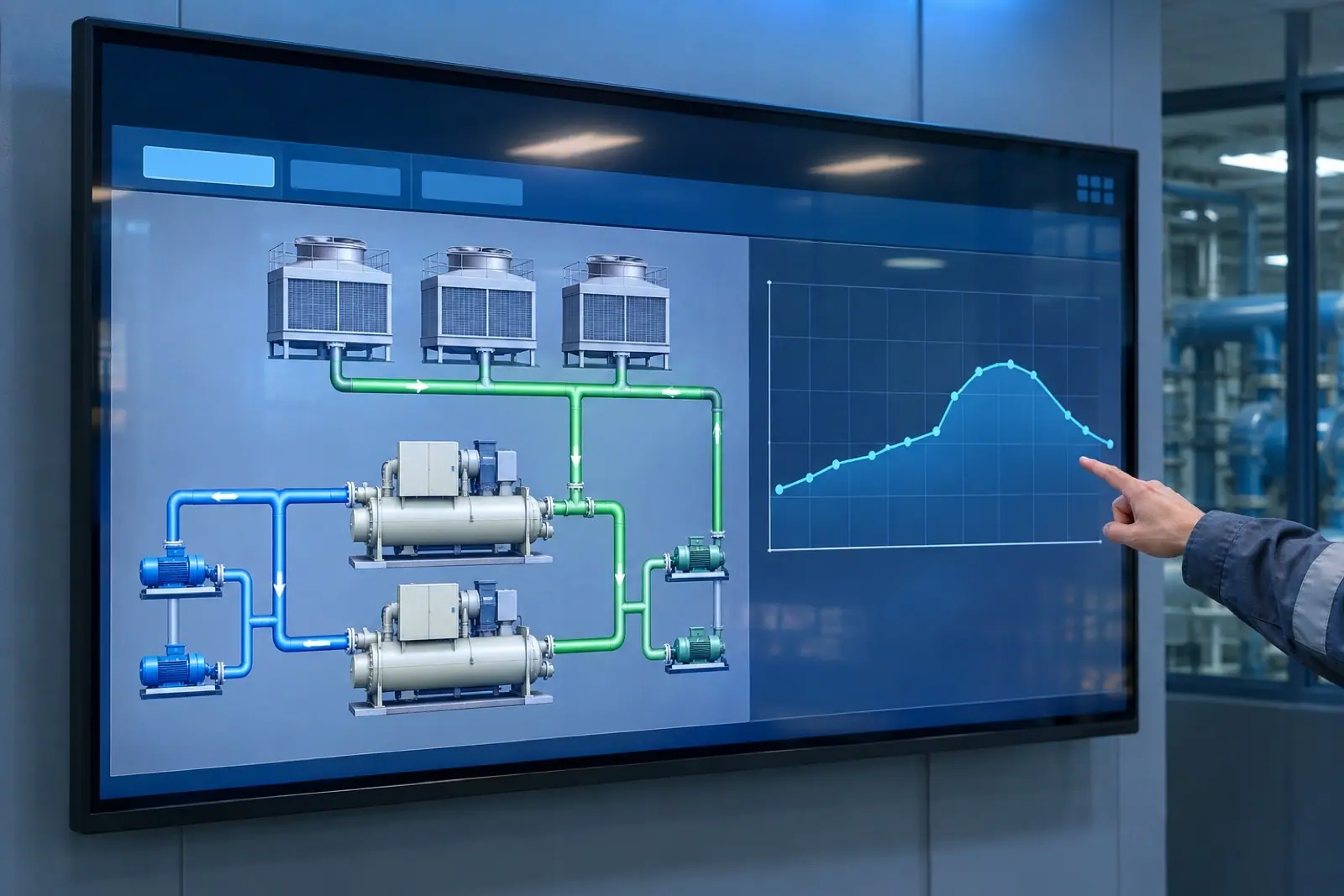
- Air conditioning and chiller plant. This is usually the largest electrical load in a commercial building in a tropical climate. Look at chiller efficiency in kilowatts per ton of refrigeration, operating hours, and the chilled-water temperature set point.
- Operating hours matched to actual use. A building that has data on how many people enter each zone by time of day can use it to set schedules for air conditioning, ventilation and lighting to match the hours when people actually use the space.
- Peak electricity demand. Staggering the start-up of large machines so they do not all start together helps reduce peak demand charges. Section 7 of the Act mentions this approach in relation to factories, and it can be applied technically to buildings.
- Lighting. Check zones where lights are left on outside operating hours, and areas that get enough natural light.
- Equipment whose efficiency declines with age, such as pumps, fans and dirty coils. A system that collects data continuously can show the trend before it turns into a higher electricity bill.
Savings differ from building to building depending on equipment condition, operating hours and usage behaviour. Measure a baseline before starting improvements, then measure the results after the improvements using the same method.
How Does IMAS Analytics Support Designated Buildings?
IMAS Analytics provides an AI-based building energy management system and, together with its partner Saturn Pyro, energy audit services for shopping centres, retail stores, airports and commercial buildings in Thailand. The system brings energy data from multiple meters and systems into one place, helps the engineering team find where energy is being wasted, and helps prepare data for the energy management work required by the ministerial regulation. IMAS also offers a people-counting system, which provides data on the hours when people actually use a space, to support the scheduling of building systems.
The building's engineering team remains the decision-maker and is responsible for the legal duties. The IMAS system helps the team see data more clearly and work faster.
See details of the building energy management service: IMAS building energy management system
Want the IMAS team to look at your building data: Contact the IMAS team
Frequently asked questions
−1. How do I know if my building is a designated building?
Check the 2 criteria in Section 3 of the Royal Decree Designating Controlled Buildings B.E. 2538 (1995). Meeting either one makes it a designated building: (1) the electricity distributor has approved an electricity meter or combined transformer installation of 1,000 kilowatts or 1,175 kilovolt-amperes or more, or (2) total energy use equivalent to electrical energy of 20 million megajoules or more in the previous calendar year, counting all buildings under the same house number together.
+2. What is the difference between a designated building and a building subject to usage control?
A designated building for energy purposes comes from the Energy Conservation Promotion Act and is determined by electricity or energy use. A "building subject to usage control" (อาคารควบคุมการใช้) comes from the Building Control Act. They are separate laws, with different duties and different regulating authorities.
+3. How many energy responsible persons are needed?
Under Clause 4 of the Ministerial Regulation Prescribing Qualifications, Duties and Number of Energy Responsible Persons B.E. 2552 (2009), a building whose combined meter or transformer size is below 3,000 kilowatts or 3,530 kilovolt-amperes, or whose total annual energy use is below 60 million megajoules, needs at least 1. A building at or above those levels needs not fewer than 2, and at least 1 of them must have completed the senior energy responsible person course or passed the examination organised by DEDE.
+4. When is the energy management report due?
Clause 11 of the Ministerial Regulation on Energy Management B.E. 2552 (2009) requires the energy management inspection and certification report for the preceding year to be submitted to the Director-General of the Department of Alternative Energy Development and Efficiency by the end of March each year. If the first year's energy management period up to 31 December is less than 180 days, the report for that period is submitted by the end of March of the following year.
+5. Can a building energy management system replace the energy responsible person or the inspector?
No. The law requires the owner of a designated building to appoint energy responsible persons who are individuals holding the prescribed qualifications, and to have the energy management inspected and certified by an inspector and certifier. A building energy management system is a tool that helps these people have complete data, analyse it faster and track results continuously.
Summary
A designated building for energy purposes is a building that meets the thresholds of 1,000 kilowatts, 1,175 kilovolt-amperes or 20 million megajoules per year under the 1995 Royal Decree. The owner must carry out energy management under the 2009 ministerial regulation, have energy responsible persons in the number and with the qualifications required, and submit the inspection and certification report by the end of March each year. This work becomes easier when energy data is collected continuously and can be traced back, which is exactly where a building energy management system supports the engineering team.
Talk to the IMAS team about building energy management systems
The legal information in this article was checked against the legal text as of 17 November 2026 (B.E. 2569). Laws may be amended afterwards. Before making any compliance decision, check with the Department of Alternative Energy Development and Efficiency (DEDE) or the building's legal adviser.
References
- Energy Conservation Promotion Act B.E. 2535 (1992), Royal Gazette Vol. 109, Part 33 A, 2 April 1992 (consolidated version by the Office of the Council of State).
- Energy Conservation Promotion Act (No. 2) B.E. 2550 (2007), Royal Gazette Vol. 124, Part 87 A, 4 December 2007.
- Royal Decree Designating Controlled Buildings B.E. 2538 (1995), Royal Gazette (Council of State edition) Vol. 112, Part 33 A, 14 August 1995.
- Ministerial Regulation Prescribing Standards, Criteria and Procedures for Energy Management in Designated Factories and Designated Buildings B.E. 2552 (2009), Royal Gazette Vol. 126, Part 47 A, 23 July 2009.
- Ministerial Regulation Prescribing Qualifications, Duties and Number of Energy Responsible Persons B.E. 2552 (2009), Royal Gazette Vol. 126, Part 49 A, 31 July 2009.
- Ministerial Regulation Prescribing Type or Size of Buildings and Standards, Criteria and Procedures for Building Design for Energy Conservation B.E. 2563 (2020), Royal Gazette Vol. 137, Part 94 A, 12 November 2020.
- Department of Alternative Energy Development and Efficiency, presentation "Approaches to driving energy savings" (published on the Ministry of Energy website, B.E. 2565 / 2022), on the 8-step energy management process and the report deadline.