
Shopping centers, airports and retail chains that plan to install a people counting system are often asked by their legal team or data protection officer, "Does this system fall under the PDPA?" The answer depends on what the system records and how the data is used. A system that outputs only hourly head counts is very different from one that records facial images or recognizes each person's phone. This article explains where Thailand's Personal Data Protection Act B.E. 2562 (2019), known as the PDPA, touches each kind of people counting system, and what an organization should check before installation. At the end of the article there is a table that matches statements in the article to the text of the law.
What the PDPA protects: starting with the definition of "personal data"
Section 6 of the PDPA defines "personal data" as "any information relating to a Person, which enables the identification of such Person, whether directly or indirectly, but not including the information of the deceased Persons in particular," and defines "Person" as a natural person.
The key phrase is "enables the identification ... whether directly or indirectly." A facial image clear enough to recognize someone is direct identification. Data that looks nameless at first glance but reveals who someone is once it is linked with other data may count as indirect identification.
In practice, the question an organization should ask about a people counting system is not only "Does the system use a camera?" but "Do the data the system creates, stores and passes on make a person identifiable, both when that data set is viewed alone and when it is combined with other data the organization holds?"
The PDPA also divides responsibility between two roles. Section 6 defines a "Data Controller" as a person or juristic person having the power and duties to make decisions regarding the collection, use or disclosure of personal data, and a "Data Processor" as one who operates "pursuant to the orders given by or on behalf of a Data Controller." In a typical people counting project, the building owner or store owner who decides to install the system is usually the controller, and the system provider may be a processor. The actual roles depend on the contract and the facts of each project.
Biometric data: the line that face analytics systems must watch
Section 26 sets the principle that certain categories of personal data, including "biometric data," must not be collected without "explicit consent of the data subject," unless one of the exceptions listed in that section applies.
The same section explains that biometric data means personal data arising from the use of techniques or technology relating to physical or behavioral characteristics of a person that can be used to uniquely identify that person, such as a facial recognition template, an iris recognition template or a fingerprint recognition template.
Some people counting systems on the market add face recognition to tell returning customers from new ones, or to separate staff from customers. In practice, if a system creates a facial template to confirm that the person walking in today is the same one as yesterday, the organization should seriously assess whether that function falls within the biometric data definition in Section 26. If it does, the burden of obtaining explicit consent becomes much heavier, and in a public space with large numbers of people passing through, obtaining that kind of consent is hard.
A system that counts people without recognizing who is who therefore reduces this issue from the design stage.
How much does each type of people counting system involve personal data?
| Technology | What the device senses | What is output or stored (varies by model and configuration) | Points to assess |
|---|---|---|---|
| Infrared beam | A broken beam | A count of events | Generally no data that identifies a person |
| 3D stereo vision sensor | Depth image from dual lenses, processed on the device | Many models export only counts, times and path coordinates | The images visible during installation and setup; the privacy level setting; who can access the settings page |
| 2D camera | Top-down image | Numbers or images, depending on the system | Whether images are stored or sent out of the device |
| Wi-Fi and Bluetooth | Signals from each person's phone | Device identifier, or a transformed value | The device identifier is tied to a person's phone; keeping it to track repeat visits may allow indirect identification |
| CCTV with AI | Full images showing faces | Video, analysis results, and in some systems a facial template | Video footage is already personal data; if faces are recognized, Section 26 must be considered |
This table is an overview. Each brand of system is designed differently. Organizations should ask the provider for documents that state clearly what data leaves the device, where it is stored, for how long and who can access it.
Anonymous counting with 3D sensors
Many 3D vision sensors used in shopping centers and airports are designed around the concept of privacy by design. An example from one vendor's documentation states that the sensor builds the depth image inside the device and exports only numerical data such as the number of people, time and path coordinates, with images neither stored nor transmitted. There are several privacy levels. The level with no restrictions is used only during installation, the highest level hides both images and paths and leaves only counts, and lowering the level requires a special key issued by the manufacturer on a verified request.
The same document also states that the sensor alone is not enough: legal compliance depends on the whole system, including the platform, the connections and the data storage.
In practice, an organization that chooses 3D sensors should check three things.
- The privacy level actually in use after installation is complete, not the level used during installation, and it should be recorded in a document.
- Who can access the settings page. During installation and angle adjustment, a technician may see a live image to position the device. There should be a clear procedure for this period covering who does it, when, and that no images are recorded and kept.
- What the data is combined with. Hourly head counts alone cannot identify anyone, but if detailed walking paths are linked with CCTV images or membership data, the result may become data that identifies a person indirectly.
The PDPA itself recognizes the idea of making data non-identifiable. Section 33 gives data subjects the right to request that the controller "erase or destroy, or anonymize the personal data" in the cases specified in that section. In practice, if the data a people counting system exports cannot identify a person either directly or indirectly, that data set does not fall within the definition of personal data in Section 6. But the organization should still assess the other steps around the system, such as the images visible during installation, the CCTV images used to check accuracy, and links to other data sets.
The household exemption does not cover businesses
Section 4 (1) exempts from the PDPA "the collection, use or disclosure of personal data by a person who collects such personal data for personal benefit or household activities of such person only." The Personal Data Protection Committee Office (PDPC) citizen's PDPA handbook says, in answering a question about home CCTV, that no warning sign is needed "if it is for crime prevention and for the homeowner's own security."
This exemption applies to personal and household use, not to commercial activity. A news report dated August 31, 2026 (B.E. 2569) quoted the PDPC Secretary-General as saying that businesses or organizations "will not receive the exemption under Section 4 (1) and must comply with the PDPA." Shopping centers, stores and airports that install people counting systems should therefore assess them under the PDPA as usual.
If the system involves personal data, what are the main duties under the PDPA?
Where the system or the steps around it involve personal data, for example when CCTV is used alongside, or when device identifiers are collected from Wi-Fi, these are the duties to consider.
Purpose and collecting only what is necessary (Sections 21 and 22)
Section 21 requires the controller to collect, use or disclose data "in accordance with the purpose notified to the data subject before or at the time of such collection." Section 22 requires that collection be "limited to the extent necessary in relation to the lawful purpose of the Data Controller."
In practice, if the purpose is to know the hourly number of people entering the mall in order to schedule staff, a system that outputs only counts already meets that purpose. Collecting images or more detailed data should have a reason to support it.
Legal basis (Section 24)
Section 24 sets the principle that personal data must not be collected without consent unless one of the listed grounds applies. One of them is Section 24 (5), where processing "is necessary for legitimate interests of the Data Controller or any other persons or juristic persons other than the Data Controller, except where such interests are overridden by the fundamental rights of the data subject in respect of his or her personal data."
In practice, an organization that relies on this basis should record the balancing it carried out: what the organization's interest is, and how much it affects visitors' rights. An anonymous system makes this balancing easier. Biometric data does not fall under Section 24 and must be considered under Section 26, as described above.
Readers should also know that when data is collected under Section 24 (5), the data subject has the right to object under Section 32 (1), unless the controller can demonstrate the grounds that section sets out.
Notifying details (Section 23)
Section 23 requires the controller to "inform the data subject, prior to or at the time of such collection of personal data" of the listed details, such as the purpose, the data collected and the retention period, the controller's identity and contact channels, and the data subject's rights, unless the data subject already knows those details.
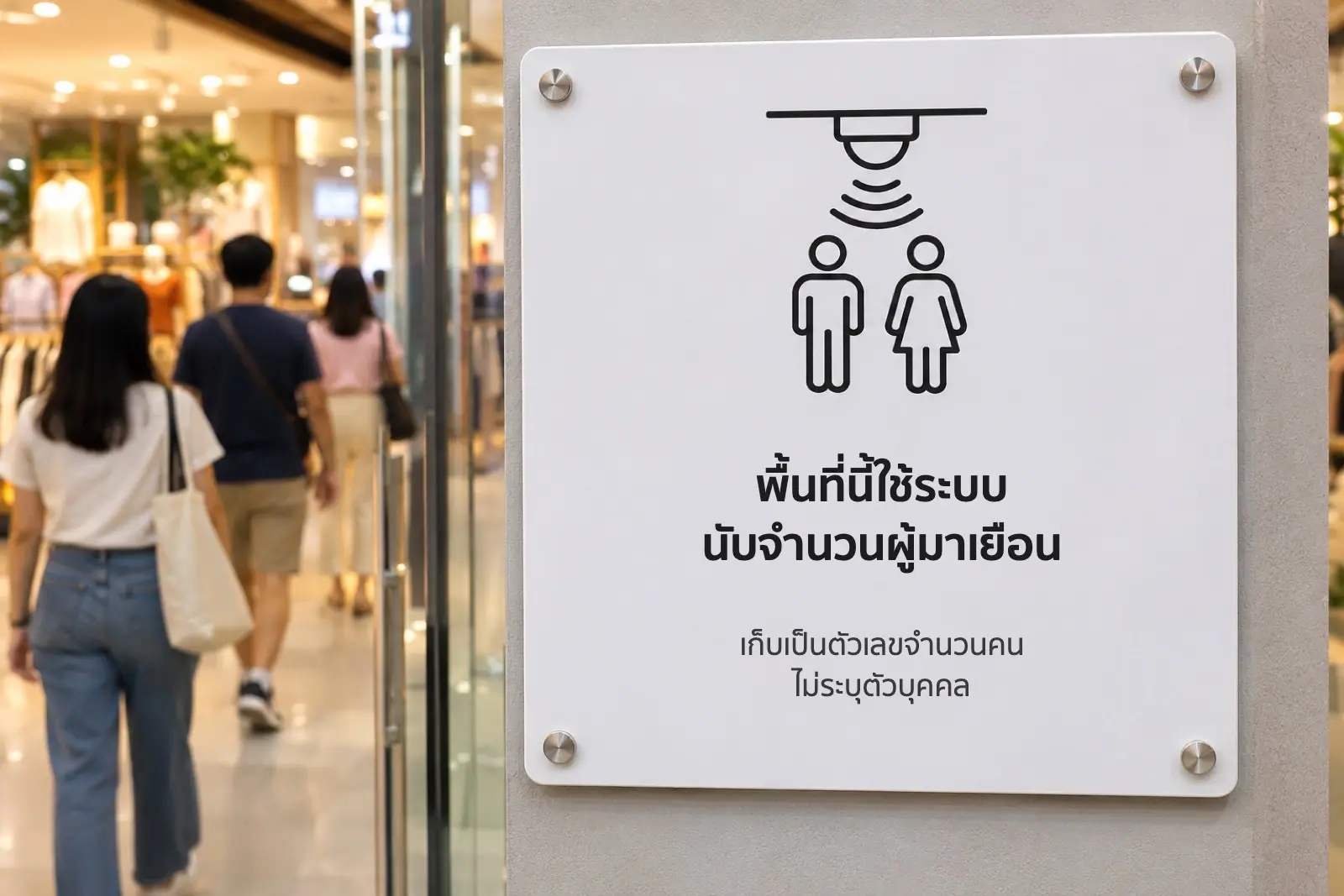
In practice, areas with large numbers of people passing through usually use a sign at the entrance alongside a full privacy notice on the website. Even if the people counting system is anonymous, a sign like this still helps build transparency with visitors.
Security, deletion and breach notification (Section 37)
Section 37 sets out several controller duties. The ones directly relevant to a people counting system are:
- Section 37 (1): provide "appropriate security measures" that meet the minimum standards announced by the Committee. In practice this includes controlling access to the sensor settings pages and the dashboard.
- Section 37 (3): put in place an examination system for erasing or destroying data when the retention period ends, or when the data is irrelevant or beyond what is necessary for the purpose.
- Section 37 (4): notify the PDPC of a personal data breach "without delay and, where feasible, within 72 hours after having become aware of it," unless the breach is unlikely to result in a risk to the rights and freedoms of persons.
Service providers, records and data protection officers (Sections 39, 40 and 41)
- Section 39 requires the controller to keep records of the specified items so that data subjects and the PDPC can inspect them.
- Section 40, paragraph three, provides that when work is assigned to a data processor, the controller "shall arrange for an agreement" between them to control the processor's work so that it complies with the law. In practice, the contract with a people counting service provider should have a personal data agreement attached, if personal data is involved.
- Section 41 (2) requires a data protection officer when the activities "require regular monitoring of the personal data or the system, by reason of having a large amount of personal data as prescribed by the Committee." Shopping centers and airports that run many CCTV cameras should check whether the organization meets this criterion.
Transfers abroad (Section 28)
Some analytics systems store data on servers outside Thailand. Section 28 provides that when personal data is sent or transferred abroad, the destination country must have "adequate personal data protection standards," in line with the criteria announced by the Committee, unless an exception listed in that section applies. If the data sent out is numerical data that cannot identify a person, this issue is smaller, but you should still ask the provider clearly where the data is stored.
Penalties under the PDPA
The PDPA has three kinds of liability and penalty provisions: civil liability in Chapter 6 (Sections 77 and 78), criminal penalties in Chapter 7, Part 1 (Sections 79 to 81), and administrative penalties in Chapter 7, Part 2 (Sections 82 to 90). Each kind applies to violations of different sections. Interested readers should read the Act itself or consult legal counsel.
Where do the PDPC's 2026 CCTV guidelines stand?
The law firm Tilleke & Gibbins reported that the PDPC ran an online questionnaire and stakeholder engagement activities in March 2026 (B.E. 2569), then held a public hearing on April 1 to 2, 2026 on several draft guidelines. One of these was on the use of CCTV and access control systems, which the report says focuses on housing estates and condominiums and covers biometric data and license plate recognition. The same report says the forthcoming guidelines will not have the force of law.
As of the date of writing (November 17, 2026), the author has not found a final version announced by the PDPC. Organizations planning a project should follow the PDPC website and update their documents when a final version appears.
Another point that is often confused: on October 1, 2026, the National Cyber Security Agency (NCSA), together with the Thai Smart CCTV Association, published "Guidelines for Cybersecurity of CCTV Systems for Thailand" and a version for cameras that use artificial intelligence. Both are about the cybersecurity of camera systems, not PDPA guidelines from the PDPC, but they can be used to support the security measures under Section 37 (1).
Checklist before installing a people counting system
| Stage | What to do | Related section |
|---|---|---|
| Before choosing a system | Write the purpose clearly, then choose a system that collects only the data the purpose needs | 21, 22 |
| Before choosing a system | Ask the provider for documents on what data leaves the device, where it is stored, for how long and who can access it | 22, 28, 37 (1) |
| Before choosing a system | If face recognition is involved, assess whether it falls under the definition of biometric data | 26 |
| During installation | Define the procedure for the adjustment stage when technicians see a live image, and confirm the privacy level after installation is complete | 37 (1) |
| Before going live | Choose the legal basis and record the balancing, if personal data is involved | 24 |
| Before going live | Put up a sign at the entrance and publish a privacy notice | 23 |
| Before going live | Make an agreement with any provider that processes data on your behalf | 40 |
| During operation | Set a retention period and a data deletion system | 37 (3) |
| During operation | Prepare a breach notification procedure | 37 (4) |
| During operation | Review every time people counting data is to be linked with another data set | 6, 21 |
The IMAS approach
IMAS Analytics uses 3D sensors from partners such as Xovis and TD Intelligence, sending visitor numbers, the time spent in an area and the places where people are crowded into the XPERIO platform. IMAS's analytics software partner positions its system as designed from the start to comply with European data protection law (GDPR). The IMAS team helps prepare documents explaining the data flow in a project, so that the organization's data protection officer can use them in an assessment. Deciding whether a project complies with the PDPA remains the job of the organization's data controller and legal counsel.
For details of the system, see IMAS people counting, and for how to choose a technology, read the People counting system buying guide for malls and retail.
Frequently asked questions
−Is a people counting system a violation of the PDPA?
A people counting system is not unlawful in itself. The question is what data the system collects and uses. If the data it produces cannot identify a person, either directly or indirectly, that data does not fall within the definition of personal data under Section 6. But if the system stores images or device identifiers, or recognizes faces, the organization must comply with the relevant PDPA duties.
+Do we have to get consent from every customer when installing a people counting sensor?
The PDPA does not make consent the only route. Section 24 lists other grounds for collecting data without consent, such as legitimate interests under Section 24 (5), subject to the conditions in that section. But for biometric data, such as a facial template, Section 26 sets the principle that explicit consent is required unless an exception in that section applies. The choice of basis should be considered by the organization's data protection officer.
+Do we have to put up a sign if the system does not store images?
If no personal data arises at all, the notification duty under Section 23 does not arise. In practice, though, many organizations choose to put up a sign saying they use an anonymous counting system, for transparency and to ease visitors' concerns. If there is also CCTV in the same area, the sign and the notice should cover both systems.
+What is biometric data under the PDPA?
Section 26 describes it as personal data arising from techniques or technology that use a person's physical or behavioral characteristics to confirm that person's identity as unique from others. The examples in the text of the Act are a facial recognition template, an iris recognition template and a fingerprint recognition template.
+Is Wi-Fi people counting riskier than 3D sensors?
Wi-Fi systems pick up signals from each person's phone, and the device identifier is tied to a person's phone. If it is stored to track repeat visits, it may allow indirect identification. Many 3D sensor models, by contrast, are designed to export only numbers. In practice, a Wi-Fi system should therefore be assessed more thoroughly, and you should look at the real configuration of both systems, not just the type of technology.
Talk to the IMAS team about anonymous counting
If your organization is planning to install a people counting system in a shopping center, store, airport or commercial building, and needs a document explaining the data flow for your legal team to assess, contact the IMAS team or request a demo. Details and pricing are given in a quotation.
See also: Past projects · Visitor forecasting system
References
- Personal Data Protection Act B.E. 2562 (2019). Royal Gazette, vol. 136, part 69 Kor, May 27, 2019 (B.E. 2562).
- Personal Data Protection Committee Office (2022). PDPA Handbook for the Public, edition of June 23, 2022 (B.E. 2565). In Thai.
- Thai Post (2026). PDPC clarifies that installing CCTV does not mean a PDPA violation. News dated August 31, 2026 (B.E. 2569). In Thai.
- Tilleke & Gibbins (2026). Thailand's Public Consultation on Proposed PDPA Guidelines: Key Updates.
- Siam Rath (2026). Download the 2 Thai CCTV security guidelines. News dated October 1, 2026 (B.E. 2569). In Thai.
- Vemco Group (2026). Xovis Sensor Security & Privacy Guide. Vendor online help document.
- IMAS Analytics (2026). Solutions and Partners pages. imas-analytics.ai website, Thai version.